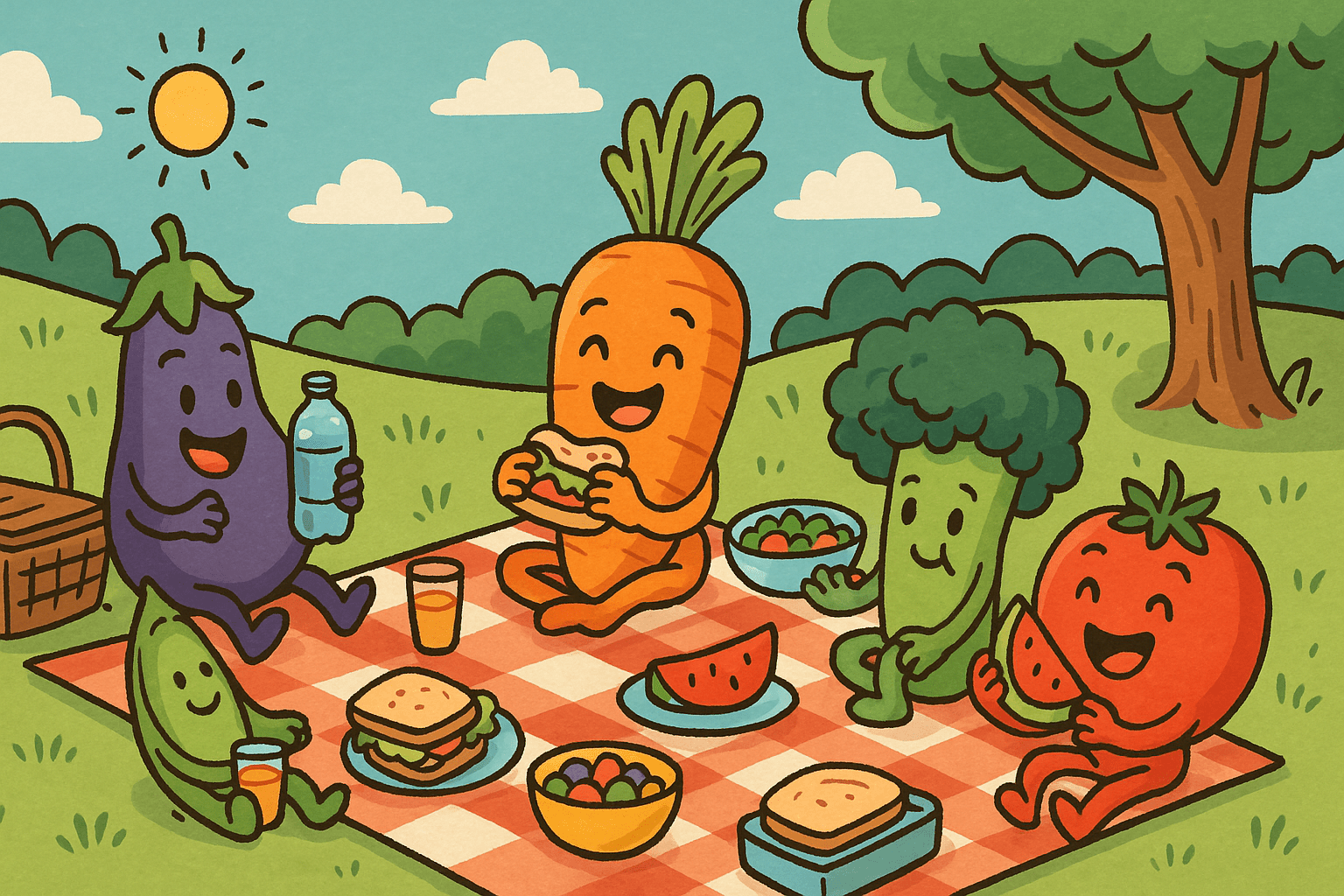
Zero plastic vegetarian picnic: containers, chilling and menu
For four people you need four rigid containers, a source of cold and four hours of margin. That is roughly it. Chilled food can stay out of the fridge for a maximum of four hours during preparation according to the UK Food Standards Agency, and that clock starts when the box leaves the fridge, not when you spread out the blanket.
Two things are worth saying straight away, because they contradict most of what is written on this subject.
First: taking plastic out of a picnic does not meaningfully cut your carbon footprint. Transport accounts for roughly 5% of global food system emissions, and processing, transport, retail and packaging combined remain a minority share, as the Our World in Data synthesis of the Poore and Nemecek meta-analysis shows. Across European diets, food transport accounts for 6% of emissions against 83% for meat, dairy and eggs. The meal is already vegetarian, so the climate work is largely done. What zero plastic solves is a waste and pollution problem, which is a legitimate goal in itself. It simply is not the same goal.
Second: several of the materials sold as the ecological alternative to plastic are, in terms of chemical migration, worse than the plastic they replace. Bamboo fibre and melamine tableware are among them. I come back to this in detail, because it is where the usual advice goes most clearly wrong.
What going plastic free actually changes
Switzerland produces around 670 kg of municipal waste per inhabitant per year, a 2024 figure from the Federal Office for the Environment, three times more than fifty years ago. Over half is collected separately and recycled. Single-use food plastic sits in the most awkward fraction: light, often soiled with greasy residue, hard to sort, and heavily over-represented in the litter found along lakeshores and at picnic spots.
A conventional picnic for four easily produces fifteen disposable items: cling film, bags of prepped vegetables, trays, bottles, cups, cutlery, napkins. Cutting them out is a real, measurable, immediate gain that involves no complicated trade-off. It is just a gain counted in grams of waste, not kilograms of CO₂.
One practical consequence follows. If your priority is climate, the question is not what you carry the food in but what the food is. A seasonal vegetarian picnic with no imported industrial cheese and no air-freighted fruit comfortably beats a meat picnic served in glass. Air freight accounts for only 0.16% of global food tonne-kilometres but emits fifty times more than shipping per tonne-kilometre, which is the one case where geographic origin genuinely changes the order of magnitude. For everything else, the food matters more than the distance it travelled. Our guide to eating with the seasons works through that logic.
Choosing containers: what migrates and what does not
This is the heart of the subject and the part where the information available online is least reliable.
Ranking the materials
Glass and glazed ceramic are the reference. They are chemically inert at the temperatures of a cold meal, clean completely, hold no odours and last for decades. Their two faults are weight and breakage. A full one-litre jar weighs close to 1.5 kg with its contents.
Food-grade stainless steel comes next, with the decisive advantage of weight and toughness. An 800 ml container in 18/8 stainless weighs around 250 g empty against 550 g for an equivalent glass jar. It suits neither the microwave nor very acidic food left in prolonged contact, but a picnic lasts a few hours, not several days.
Bare or oiled wood, for boards and cutlery, causes no problem provided it is cleaned and dried properly. It stays porous, so it is not for carrying anything wet.
Wax wraps, beeswax or plant wax, replace cling film for covering a dish, wrapping bread or a piece of hard cheese. They are not airtight, do not suit liquids, wash only in cold water and lose their grip after a few dozen washes.
The melamine and bamboo fibre trap
Bamboo and “BPA-free melamine” tableware are routinely presented as a clean alternative to disposables. That is the advice I am correcting first.
A study published in Toxics in 2024 tested 46 bowls and cups made from melamine, bamboo fibre and wheat straw bought from retailers, with four glass or ceramic items as controls, under the migration conditions set by the European Union Reference Laboratory (Europe PMC 38393238). Total migration of melamine and its derivatives ranked as follows: bamboo above melamine, above wheat straw, above glass and ceramic, with a highly significant difference. Comparing the measured concentrations against the strictest tolerable daily intake, the authors obtained a hazard quotient of 1 or more for 53.5% of melamine items and 92.3% of bamboo fibre items in adults. For a one-year-old child, those proportions rose to 86.0% and 100%.
The reason is simple and rarely explained: so-called bamboo tableware is not bamboo. It is a melamine-formaldehyde resin filled with bamboo fibres. Adding plant fibre weakens the resin network and increases migration rather than reducing it. The marketing sells a natural material; the chemistry delivers a thermoset less stable than pure melamine.
The practical conclusion: for a picnic, melamine and bamboo fibre tableware is not an improvement on reusable plastic. Stainless steel, glass, ceramic or solid wood, or nothing.
Where BPA stands now
Bisphenol A deserves an update, because the regulation changed recently and a great many articles online are still describing the 2015 position.
In April 2023 EFSA re-evaluated BPA and set a tolerable daily intake of 0.2 nanograms per kilogram of body weight, 20,000 times lower than the temporary 4 micrograms adopted in 2015. The immune system turned out to be the most sensitive target. Against exposure estimates, every age group exceeds that TDI by two to three orders of magnitude. On that basis the European Commission adopted Regulation (EU) 2024/3190 on 19 December 2024, banning BPA in materials intended to come into contact with food. EFSA is still preparing a statement on the other bisphenols, expected in January 2027 according to its topic page.
Switzerland follows the same framework. Annex 2 of the FDHA Ordinance on materials and articles intended to come into contact with foodstuffs, SR 817.023.21, provides that BPA and its salts may only be used in accordance with article 3 paragraph 2 and annex II of the European regulation, and sets the detection limit of the verification method at 1 microgram per kilogram.
What this means for you: “BPA free” on a box sold today in Switzerland or the EU is no longer a distinguishing claim, it is the baseline legal requirement. It says nothing about other bisphenols or about polymer additives. If you already own reusable plastic boxes in good condition, throwing them out to buy stainless steel is a poor environmental trade. Use them to the end, do not heat them, replace them once they scratch or warp, and buy stainless or glass when the time comes.
The cold chain is the real constraint
Going plastic free shifts a problem. By dropping disposable packaging you also give up the easy options and take on temperature management yourself. That is where most failed picnics are decided, and picnic guides say almost nothing about it.
The numbers to work from
The Food Standards Agency gives thresholds you can use as they stand. The fridge should be between 0 and 5 °C, the freezer around −18 °C. Chilled food tolerates a cumulative maximum of four hours out of the fridge during preparation. The danger zone, where bacteria multiply fastest, runs from 8 to 63 °C. A cooked dish should be cooled and refrigerated within one to two hours, and leftovers eaten within 48 hours or frozen.
In Switzerland, the FDHA Ordinance on hygiene, SR 817.024.1, sets the principle that applies to professionals and transfers well to the home kitchen: the cold chain must not be broken, and a rise in temperature is tolerated only briefly during transport.
Building a cold source without disposables
A rigid cool box or an insulated bag holds cold in; it does not produce any. So you have to put a reserve of cold inside it. Three approaches work without buying anything disposable.
Freeze a stainless steel bottle filled three-quarters with water the night before. It chills the bag through the morning, then becomes drinking water in the afternoon. Leave room for expansion: a bottle filled to the brim and frozen will deform or split.
Freeze part of the meal. A chilled soup, a hummus or a fruit salad taken out of the freezer at the last moment doubles as an ice block and is thawed by lunchtime. That turns a constraint into free refrigeration.
Pre-chill the containers themselves. Glass and ceramic have high thermal inertia, which is normally presented purely as a weight penalty. A jar taken out of the fridge at 4 °C stores cold and releases it slowly. Conversely, a jar filled at room temperature warms the whole bag.
One last point, often overlooked: park the bag in the shade and set it on the grass rather than in a car boot. The inside of a car in the sun climbs well past the danger zone within an hour.
How much cold do you need
One order of magnitude helps with sizing. A litre of frozen water absorbs roughly 93 watt-hours of latent heat as it melts, about eighty times what the same water absorbs warming by one degree. In other words, the phase change from ice to water does the real cooling work, not the fact that the bottle is cold. A bottle merely taken from the fridge does almost nothing in a bag; a frozen one lasts half a day.
Two practical consequences follow. Pack the frozen items as late as possible and keep the bag closed, since every opening swaps cold air for warm. And prefer one large frozen block to three small ones. A large block has less surface relative to its volume and therefore melts more slowly.
Which dishes really survive the journey
A recipe is not chosen on taste alone when it has to spend three hours in a bag. Three categories carry documented problems, and picnic guides rarely mention any of them.
Rice and cooked grains
This is the most underestimated risk of a vegetarian picnic, precisely because these dishes so often stand in for meat. Bacillus cereus forms spores that survive cooking. A study in Foods in 2023 followed eight spore strains in cooked rice held at 4, 25 and 30 °C (Europe PMC 36766153). Four strains grew at 30 °C and three at 25 °C, with rapid growth from six hours at 30 °C. At 4 °C, no growth.
The problem is that the emetic toxin produced, cereulide, is extremely stable and is unlikely to be inactivated by heat processing, as a review published the same year points out (Europe PMC 36832907). Reheating rice left at room temperature fixes nothing.
In practice: cool the grain quickly after cooking, spread thin rather than left in the pan, refrigerate within one to two hours, and carry it cold. A rice, bulgur or quinoa salad made the day before and kept chilled is fine. The same salad forgotten for two hours on a warm worktop, then carried three hours in a lukewarm bag, is not.
Raw sprouted seeds
Sprouts are often recommended for picnic freshness. That advice needs serious qualification.
Two Nordic outbreaks in late 2024 implicated alfalfa sprouts. In Sweden, a matched case-control study of 100 Salmonella Typhimurium ST36 cases found an adjusted odds ratio of 8.94, 95% confidence interval 2.96 to 27.1, for eating alfalfa sprouts (Europe PMC 40916032). In Norway, 230 cases across four serovars were linked to the same products by whole-genome sequencing, with 33% hospitalised (Europe PMC 40394450). In both, contamination traced back to the seeds rather than to the sprouting itself, which means impeccable jar hygiene at home does not rule it out.
None of this condemns home sprouting, which remains a worthwhile practice and which we cover in our guide to sprouting sunflower seeds. It means raw sprouts have no place in a lukewarm picnic basket, and that they are avoided altogether for pregnant women, young children, older people and anyone immunocompromised. Cooked for a minute in a pan they lose their crunch, and the risk with it.
Ready-to-eat chilled dishes
The NHS lists pre-prepared sandwiches and salads, pre-cut fruit and soft mould-ripened or blue-veined cheeses among the main sources of Listeria monocytogenes infection (NHS Listeriosis). Listeriosis is mild or symptomless in most healthy adults. It is serious in pregnancy, where it carries a risk of miscarriage or stillbirth, in newborns, in immunocompromised people and in older people.
The consequence for a picnic is concrete: for those profiles, move the dial. Fruit cut on the spot rather than the night before, hard cheeses rather than brie or gorgonzola, sandwiches assembled at the last minute rather than in the morning.
What travels well
Some categories, by contrast, behave beautifully over three hours. Cooked and dressed pulses improve with time. Cold roasted vegetables barely weep. Acidic spreads, lemon-heavy hummus, aubergine caviar, tapenade, are stable and travel in a jar. Thick frittatas and quiches cut into clean slices. Whole raw vegetables, radishes, carrots, cucumbers, hold up far better than grated ones. Thick-skinned fruit travels with no protection at all.
Behind those examples sits a simple rule: what travels is either dry, acidic or whole. Dry preparations such as roasted chickpeas or crackers hold too little free water for bacteria to grow. Acidic preparations below roughly pH 4.5, meaning anything with plenty of lemon, vinegar or lactic fermentation, slow that same growth chemically. Whole foods, finally, keep an intact skin, a barrier that disappears the moment you peel or cut them. A whole apple and the same apple in wedges are not the same food microbiologically.
The kit, weighed for four people
Here is what I actually carry, with rough figures.
One rigid 1.5 to 2 litre container for the main dish, ideally stainless for the weight. Two 500 to 750 ml jars, one for a spread, one for a salad or fruit. One 800 ml container for dessert. Two one-litre bottles, one frozen the night before. Four stainless or enamel plates, around 150 g each. Four sets of cutlery from the kitchen drawer, which costs nothing and creates no waste. A paring knife in a cloth sheath. A thin wooden board, which doubles as a serving tray. A cotton tea towel that serves as tablecloth, kitchen roll and wrapping. Two wax wraps. One empty folded cloth bag for waste and dirty linen on the way home.
Total: roughly 3.5 to 4.5 kg of empty containers and tableware for four, against under a kilo in disposables. That is the real cost of going plastic free, and it is physical rather than financial. By bike or on a hike you scale down: one large container, bottles, cutlery, and no glass jars.
For the basic kit and how to renew it gradually, our article on ten durable items that replace plastic in the kitchen sets out the trade-offs.
Buying in Switzerland
Stainless containers with a silicone gasket turn up in general retail, in camping shops and in zero waste stores, usually between 20 and 45 francs for 800 to 1200 ml. Look for the 18/8 or 18/10 marking and for a gasket you can pull out to clean; permanently glued seals turn musty within a year. Clip-top preserving jars cost three to eight francs and are the cheapest solution of all, provided you accept the weight.
With wax wraps, the composition is worth checking. Beeswax on its own grips poorly; the usable wraps also contain jojoba or coconut oil and tree resin. Vegan versions use candelilla or carnauba wax. Both types can be refreshed at home by placing the cloth between two sheets of baking paper and pressing briefly with an iron.
For unpackaged vegetables and bread, farm shops, weekly markets and zero waste stores are the obvious addresses. If you bring your own container to the counter, hand it over clean and dry; businesses are entitled to refuse it under their own hygiene controls if it is visibly soiled.
Three recipes built for transport
Quantities serve four and are weighed, because the balance of a pulse salad rests on the ratio between the pulse, the acid and the fat, not on inspiration.
Green lentil salad with roast beetroot and hazelnuts
250 g dried green lentils, 400 g beetroot, 60 g hazelnuts, 80 g feta or smoked tofu, 4 tablespoons rapeseed oil, 3 tablespoons red wine vinegar, 1 teaspoon mustard, a bunch of flat-leaf parsley, salt, pepper.
Cook the lentils for 20 to 25 minutes in three times their volume of unsalted water, salting at the end. Roast the beetroot cut into 2 cm cubes for 35 minutes at 200 °C. Toast the hazelnuts dry and crush them. Dress the lentils while still warm, since they absorb better. Cool quickly, spread on a tray rather than left in a mass. Add beetroot, cheese and hazelnuts only when filling the container, or everything turns pink. Keeps 48 hours in the fridge and handles three chilled hours in an insulated bag.
Thick courgette and mint frittata
8 eggs, 500 g courgettes, 1 onion, 60 g parmesan or nutritional yeast, 20 mint leaves, 2 tablespoons olive oil, salt, pepper.
Grate the courgettes, salt them, leave to drain for 20 minutes, then squeeze firmly. This step is not optional: a frittata weeps in transit if the courgettes were not wrung out, and the slice falls apart. Soften the onion, add the courgettes for five minutes, combine with the beaten eggs, the cheese and the chopped mint. Bake for 25 minutes at 180 °C in a 22 cm tin. Cool completely before slicing, otherwise the pieces crumble. Carry in a rigid container, slices stacked with reused baking paper between them.
Chickpea hummus with preserved lemon
400 g cooked drained chickpeas, 90 g tahini, juice of one and a half lemons, a quarter of a preserved lemon, 1 garlic clove, 1 teaspoon cumin, 6 tablespoons iced water, salt.
Blend the tahini with the lemon juice and iced water before adding the chickpeas: the tahini pales and turns creamy, and the hummus stays light. Add the garlic, cumin and the rinsed, chopped preserved lemon. Adjust the salt. The lemon acidity is not only about flavour; it lowers the pH and limits bacterial growth in transit. Keeps three days in the fridge. More variations appear in our quick blender recipes.
For formats already designed to travel in a jar, see our jar salads for the week, and for larger gatherings, our local seasonal appetiser buffet.
On site: hygiene, water, waste
Washing hands without a disposable wipe takes a little organisation: a dedicated water bottle, a bar of soap in a metal tin, a towel. It is the highest-value habit of the whole meal, well above the choice of container material, because cross-contamination via hands is the commonest route of transmission in domestic food poisoning.
Serve with serving spoons rather than letting everyone dip their own fork into the shared container. That rule has an extra benefit at a picnic: what stays untouched can go home again, what four people have handled cannot.
For leftovers, the NHS rule applies in reverse: if the box has been out of the fridge for more than four hours, it does not go back in for tomorrow. The 48 hours allowed for leftovers assume rapid cooling, not a warm afternoon followed by a return to the fridge.
Take everything home, peelings and cores included. Organic waste left on site attracts crows and foxes, changes their feeding behaviour and ends up harming the animals people think they are feeding. A cloth bag folded into the bottom of the basket is enough to carry it all back.
On water: public fountains in Swiss towns and villages run drinking water unless a sign says otherwise. A “kein Trinkwasser” or “eau non potable” notice means untested spring or lake water that does not belong in a glass. Stream and lake water stays out of the bottle regardless of how clear it looks. Two full one-litre bottles for four people on a warm afternoon is tight; plan on three and work a fountain into the route.
Six common mistakes
Cooking the night before and leaving the dish to cool on the worktop overnight. It spends the night in the danger zone. Cool fast, then refrigerate.
Starting the clock at departure. The four-hour count begins when the food leaves the cold, so preparation time counts too.
Filling an insulated bag with room-temperature dishes. The bag chills nothing; it only slows warming.
Buying a full bamboo fibre set to be environmentally sound. That was the highest-migrating material in the 2024 Toxics study, ahead of pure melamine.
Replacing plastic boxes in good condition to switch to stainless. The environmental benefit of the new box takes years to offset its manufacture.
Carrying a salad dressed since the night before with tender leaves. Rocket and lamb’s lettuce collapse within two hours. Dressing travels separately, in a small jar.
Adapting to different profiles
For a pregnant woman, avoid raw sprouts, soft mould-ripened and blue-veined cheeses, ready-to-eat chilled dishes prepared long in advance, and fruit cut the day before. Hard cheeses, dishes cooked the same day and whole fruit raise no such issue.
For a young child, the main constraint is the same, plus the heightened sensitivity to melamine migration noted in the Toxics study. Stainless or enamel plate, no resin tableware, including the kind sold as natural.
For an immunocompromised or elderly person, the safety margin narrows further: dishes cooked the same day, strict chilled transport, nothing raw prepared in advance.
In hot weather above 30 °C, cut the four-hour window to two and lean on acidic preparations and whole fruit. A mayonnaise potato salad or a frittata left three hours at 32 °C is exactly the scenario to avoid.
Uncertainties and applicable guidance
The migration data in the 2024 Toxics study concern items bought in China, under a worst-case protocol. The exact proportions do not transfer directly to the Swiss market, where controls differ. The relative ranking between materials does hold: it is an effect of resin composition, not of provenance.
The Food Standards Agency figures apply to the United Kingdom. They are consistent with the principles of the Swiss hygiene ordinance, but Switzerland publishes no equally explicit consumer-facing figures for domestic preparation. The British thresholds are used because they are plainly stated, verifiable and clearly sourced.
Finally, I know of no life cycle assessment that precisely compares a glass and stainless picnic kit with its disposable equivalent, taking in washing, carrying the extra weight and real service life. The reasoning here stays qualitative on that point.
Frequently asked questions
How long does homemade hummus keep out of the fridge? Assume the same cumulative four-hour limit as any chilled preparation. Lemon acidity helps; it does not pause the clock.
Is an insulated bag with no ice block worth anything? It slows warming, and that is all. With no cold source inside, the temperature climbs, more slowly but surely. A frozen bottle solves it.
Is glass really safer than modern food-grade plastic? On chemical migration, yes, glass is inert. On the overall balance, the reusable plastic you already own and do not heat remains a reasonable choice until it needs replacing.
Can I take rice cooked the day before? Yes, provided it was cooled quickly and refrigerated within one to two hours, then carried cold. Slow cooling is the problem, not the fact that it was made in advance.
Do wax wraps work for a sandwich? Yes for a dry sandwich or a slice of tart. No for anything liquid or hot and greasy, and never in contact with food that will be reheated.
Should all cheese be avoided? No. Hard and semi-hard cheeses, Gruyère, Sbrinz, Tête de Moine, are not among the risk foods listed by the NHS. It is the soft mould-ripened and blue-veined cheeses that call for caution among sensitive groups.
Does a zero plastic picnic cost more? To buy, yes; to use, no. A stainless container costs 20 to 40 francs and lasts twenty years. The genuinely wasteful move is rebuying kit you already own in working order.
Sources
- Food Standards Agency, How to chill, freeze and defrost food safely
- NHS, Listeriosis and NHS, Food poisoning
- FDHA Ordinance on hygiene in food handling, SR 817.024.1
- FDHA Ordinance on materials and articles intended to come into contact with foodstuffs, SR 817.023.21
- Regulation (EU) 2024/3190 on bisphenol A in food contact materials and EFSA, Bisphenol A and other bisphenols
- Yang et al., Toxics 2024, migration of melamine and its derivatives from melamine, bamboo and wheat straw tableware (Europe PMC 38393238)
- Sadiq et al., Foods 2023, post-cooking survival and growth of Bacillus cereus spores in rice (Europe PMC 36766153) and review of cereulide (Europe PMC 36832907)
- Alfalfa sprout outbreaks, Sweden (Europe PMC 40916032) and Norway (Europe PMC 40394450)
- Our World in Data, Food choice vs eating local and Environmental impacts of food
- Swiss Federal Office for the Environment, waste
For the organisation of the meal itself and the detail of the safety rules, our safety-focused vegetarian picnic plan complements this one, and our guide to organising a zero waste plant-based pantry covers storage upstream.