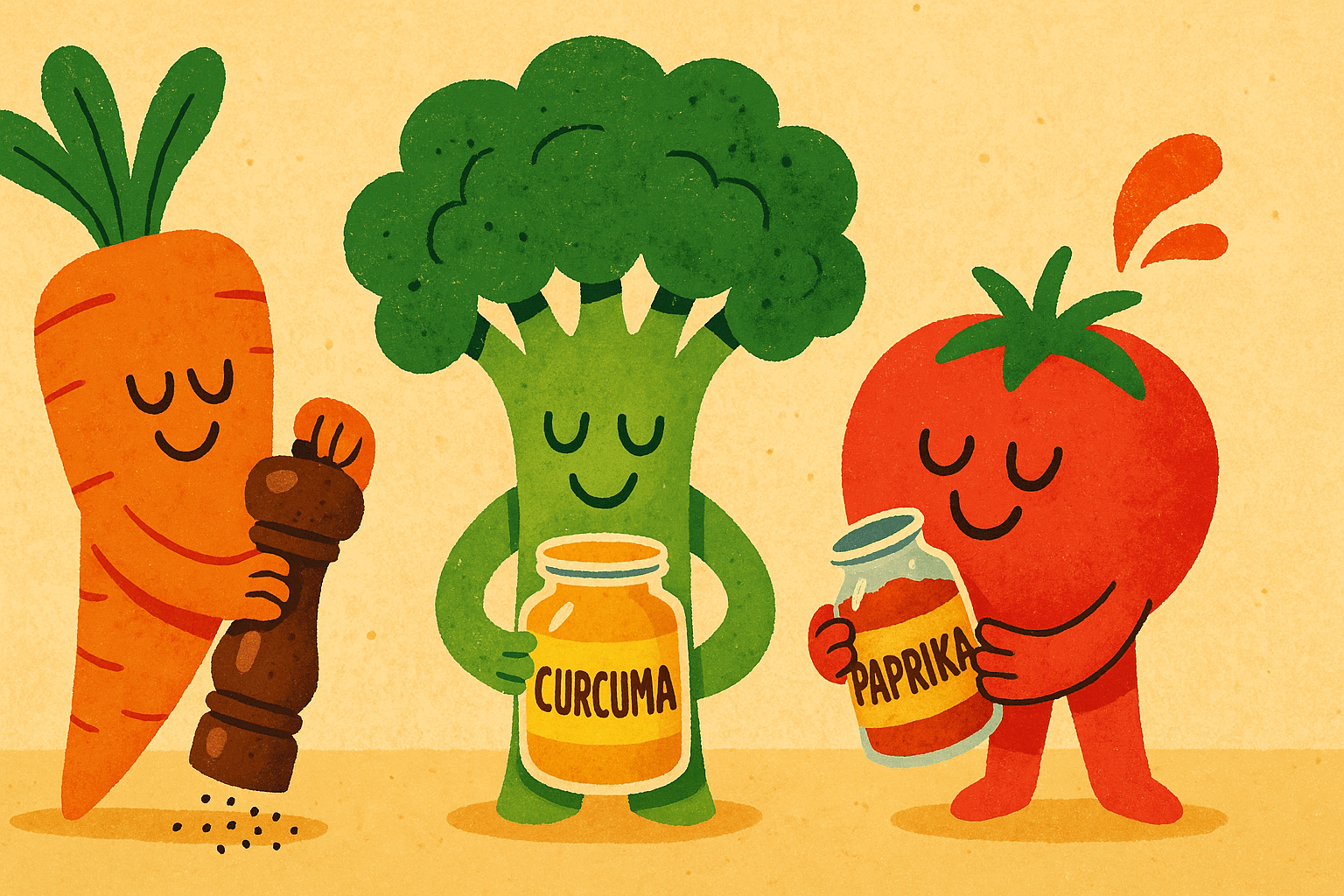
Seven everyday spices: what the evidence actually shows
A level teaspoon of ground spice weighs about 2 grams. That number decides almost everything that follows. The clinical trials behind the headlines about turmeric or cinnamon use capsules dosed at 1, 3 or 6 grams of active compound per day, usually for twelve weeks. Your curry contains a fraction of that. The two situations have almost nothing in common, and confusing them is the single most common error on this subject.
That does not make spices pointless. They do three things very well: they make meat-free cooking genuinely appetising, they let you use far less salt, and a few of them contribute meaningful micronutrients by the spoonful. What they do not do is treat disease. Here is what can honestly be said about the seven spices most likely to sit in a vegetarian kitchen, with real doses and the warnings that matter.
Culinary dose versus supplement dose
The National Center for Complementary and Integrative Health (NCCIH), part of the US National Institutes of Health, publishes evidence summaries for most medicinal plants. Its verdict on turmeric is blunt: we do not know enough to conclude definitively that turmeric or curcumin is beneficial for any health purpose. On cinnamon it is even more direct: research does not clearly support using cinnamon for any health condition. Both statements refer to concentrated supplements taken at doses far above anything you would put in a pan.
Three things explain the gap.
The first is quantity. A typical cinnamon trial gives 1 to 6 g of extract a day. The peak effect in the 2025 dose-response meta-analysis sits at 6000 mg per day, which is more than two teaspoons of pure powder, every day, for months.
The second is bioavailability. Curcumin, the yellow pigment in turmeric, is lipophilic, poorly absorbed and rapidly cleared. In one trial in healthy people, 12 g of curcumin a day produced only a very small rise in serum concentration. What you swallow and what reaches your tissues are different things.
The third is trial quality. The most complete meta-analysis of cinnamon and cardiovascular risk factors, published in 2025 in the Journal of Health, Population and Nutrition, pooled 49 randomised trials and reports reductions in fasting glucose, HbA1c and cholesterol. The same authors note that 43 of those 49 trials were rated poor quality, mainly for failures in allocation concealment and blinding of outcome assessment. A statistically significant pooled result built on poorly conducted trials stays fragile.
So read what follows this way: spices are a cooking tool with a few welcome side effects, not a substitute pharmacy. If your main goal is cutting salt, our guide to seasoning without salt using herbs, spices and citrus covers that lever properly, and our overview of essential spices and herbs for flavourful veggie cooking is a good starting cupboard.
1. Turmeric
Turmeric is the dried, ground rhizome of Curcuma longa, a plant in the ginger family. Its colour comes from curcuminoids, chiefly curcumin, which typically makes up 2 to 5 per cent of the powder. A teaspoon of ground turmeric therefore contains roughly 40 to 100 mg of curcumin, against the 500 to 2000 mg used in trials.
In cooking it is a base note rather than a top note. The flavour is earthy and slightly bitter, and it only opens up after contact with hot fat. Fry it for ten to twenty seconds in oil with the onion before adding liquid, otherwise you get colour without aroma. It holds up well in coconut milk stews, red lentil soups and roasted vegetables.
Nutritionally, 2 g of ground turmeric provides about 1.1 mg of iron and 42 mg of potassium according to the USDA FoodData Central database. That iron is non-haem and sits in a high-fibre matrix, so absorption is poor. Treat it as a top-up, not a source. Our article on optimising plant-based iron absorption explains which levers actually matter.
Two safety points are worth knowing. The NCCIH reports that high-bioavailability curcumin formulations sold as supplements have been linked to liver damage in some people. The culinary spice is not implicated, but that distinction is rarely made on the shelf. Our piece on the power of so-called anti-inflammatory spices looks at what that label really covers. Second, ground turmeric is one of the spices most affected by lead adulteration, and I come back to that below because it is the genuine risk here.
2. Cinnamon
Two very different barks are sold under one name. Ceylon cinnamon (Cinnamomum verum), thin, papery and pale, crumbles between your fingers. Cassia cinnamon (Cinnamomum aromaticum), thicker, darker and hard, dominates the European and North American trade and costs considerably less.
The difference is not only about flavour. Cassia contains roughly 1 mg of coumarin per gram, against under 0.01 mg per gram for Ceylon. Coumarin is hepatotoxic in susceptible people, and the tolerable daily intake used in Europe is 0.1 mg per kilogram of body weight, so 6 mg for a 60 kg adult. A level teaspoon of Cassia weighs about 2.6 g and delivers roughly 2.6 mg of coumarin. An occasional spoonful is no issue at all. Two or three spoonfuls daily, year round, in porridge and hot drinks, brings you close to the limit, and the NCCIH notes that prolonged Cassia use could be a problem for sensitive people such as those with liver disease.
In practice: keep Cassia for savoury cooking and occasional use, and buy Ceylon if you use cinnamon every morning. Labels often state origin (Sri Lanka for Ceylon; China, Vietnam or Indonesia for Cassia) even when they do not name the species.
Cinnamon is badly underused in savoury food. Half a stick in a carrot and chickpea tagine, or a quarter teaspoon in a red bean chilli, adds a depth most people never identify as cinnamon. It also softens perceived acidity in long-simmered tomato sauces. Middle Eastern spice traditions use it in exactly this savoury register.
3. Paprika
Paprika is dried, ground sweet pepper (Capsicum annuum). It is the one spice on this list whose nutritional contribution is genuinely visible at spoon scale: 100 g of paprika contains 2460 µg of retinol activity equivalents of vitamin A, which puts a 2 g teaspoon at roughly 49 µg, close to 7 per cent of an adult reference intake. Not a supplement, but more than most condiments manage.
Three families are worth keeping. Sweet paprika, for colour and a fruity base. Spanish smoked paprika, or pimentón, dried over oak fires, which single-handedly gives a vegetarian dish a grilled character. And hot paprika, less common, for when you want heat with colour.
Its weakness is dry heat: the carotenoids that carry the colour brown quickly. Add it off the heat or into liquid, never into a scorching dry pan, or you get bitterness. Our tahini sauces with lemon, beetroot and smoked spices use pimentón in a cold base, which protects its aroma completely.
4. Cumin
Cumin (Cuminum cyminum) is the seed that underpins much of Indian, North African, Mexican and Levantine cooking. Its aroma rests on cuminaldehyde, a volatile that disappears fast, which is why the gap between seeds toasted a minute ago and powder from the back of the cupboard is more dramatic here than for any other spice.
Method: heat a dry pan over medium heat, add the seeds, stir for thirty to forty-five seconds until the smell rises and the colour darkens one shade, then get them off the hot surface immediately. They keep cooking in a hot pan and go from toasted to burnt in about fifteen seconds.
On iron, one number circulates constantly: 66.4 mg per 100 g according to the USDA, which is genuinely enormous. The plate reality is smaller, since 2 g of seed delivers 1.3 mg of non-haem iron inside a matrix that is 10.5 per cent fibre. Useful cumulatively across a day, not a strategy against anaemia.
On digestion, the usual claim rests on thin ground. The study most often cited is a 2013 Iranian case series of 57 patients with irritable bowel syndrome, with no control group and no blinding, using cumin essential oil. Patients reported less pain and bloating, but that design cannot separate the product from natural fluctuation and placebo. Our piece on herbal teas and spice blends for digestion treats the topic without promising more than is known.
5. Ginger
This is the spice with the strongest clinical file on the list, and also the one where shortcuts are most common. The NCCIH sums up the evidence like this: ginger appears helpful for nausea and vomiting associated with pregnancy; most studies of ginger for motion sickness have not shown it to help; its value alongside standard treatment for chemotherapy-related or post-operative nausea remains uncertain. The NHS likewise lists ginger among the things that may help with early pregnancy sickness, while advising you check with a pharmacist before taking ginger supplements in pregnancy.
Note the nuance: motion sickness, cited everywhere as the obvious use, is precisely where the trials come back negative. And these results concern dosed supplements, not a slice in a mug of hot water.
In the kitchen, fresh and ground ginger are not interchangeable. Fresh is sharp, lemony and peppery, and it degrades under long cooking, so add it late in a stir-fry or grate it raw over the finished dish. Ground is warmer, sweeter and better suited to doughs, compotes and slow-cooked blends. Reckon on roughly a quarter teaspoon of ground for a tablespoon of grated fresh, understanding that the result will be different rather than identical.
Possible side effects per the NCCIH: abdominal discomfort, heartburn, diarrhoea, and mouth and throat irritation. Nothing dangerous, but common enough to explain why some people cannot tolerate very strong infusions.
6. Black pepper
Pepper is the dried berry of Piper nigrum, and its bite comes from piperine. This is the spice carrying the most persistent claim on the list: that pairing pepper with turmeric multiplies curcumin absorption twentyfold. That figure comes from a 1998 trial using 20 mg of purified piperine, equivalent to roughly 400 mg of pure pepper, far more than a few grinds.
Recent work complicates the picture considerably. A Caco-2 cell permeability study published in 2024 compared a curcumin-piperine combination with dried, crushed turmeric rhizome. Curcumin permeability was low in both cases, and lower for the combination than for the whole rhizome. The authors concluded that curcumin bioavailability in vivo may be low when co-administered with piperine.
There is a more important point that rarely gets mentioned. Piperine activates the human pregnane X receptor and induces expression of CYP3A4 and multidrug resistance protein 1, while separately inhibiting the activity of those same enzymes. A 2017 comparative study ranks piperine among the potent CYP3A4 inhibitors with an IC50 of 2.12 µM, alongside capsaicin. CYP3A4 metabolises a large share of common medicines. In other words, what gets marketed as a natural absorption booster is a drug interaction mechanism. At pepper-mill quantities this has no practical consequence. At supplement doses of “turmeric plus black pepper”, it is worth raising with your doctor or pharmacist if you take long-term medication.
One kitchen tip needs correcting along the way. You often read that pepper should go in at the end to preserve its properties. Piperine, which carries the heat, is reasonably heat stable. What is lost are the volatile terpenes responsible for the floral, woody perfume. So do add pepper late, for aroma, grind it to order, and buy it whole: ground pepper loses most of what makes it interesting within a few months.
7. Cayenne chilli
The heat comes from capsaicin, which acts on the TRPV1 receptor, the same one that responds to actual heat. Burning without injury: your mouth reports a temperature it is not experiencing.
Two lines of evidence circulate about it, and neither says what people claim.
The first concerns metabolism. A respiration chamber trial published in 2013 gave 2.56 mg of capsaicin per meal, about 1.03 g of red chilli, to volunteers in energy deficit. Resting energy expenditure and diet-induced thermogenesis did not fall as far as they normally do under restriction, and fat oxidation was higher. That is partial compensation, measured over thirty-six hours in laboratory conditions. It is not a weight loss method, and the authors do not present it as one.
The second concerns mortality. A US cohort of 16,179 adults followed for nearly nineteen years found lower death risk among regular red chilli eaters, with an adjusted hazard ratio of 0.87. A 2021 meta-analysis pooling four cohorts and 564,748 adults lands at 0.88 for all-cause mortality. These are observational associations: people who regularly eat spicy food differ from those who do not in cuisine, background and lifestyle. None of these studies shows that chilli extends life.
In cooking, add cayenne on the tip of a knife and taste before adding more, because capsaicin dissolves into fats and keeps releasing during cooking: a dish that seemed correctly seasoned in the pan can be searing after twenty minutes of simmering. At high doses chilli irritates the gastric lining and worsens reflux.
What your spices actually deliver per spoon
Values per 2 g, one level teaspoon, calculated from the USDA FoodData Central database:
- Ground turmeric: 1.10 mg iron, 42 mg potassium, 0.45 g fibre
- Cumin seed: 1.33 mg iron, 19 mg calcium, 36 mg potassium
- Sweet paprika: 0.42 mg iron, 49 µg retinol activity equivalents, 46 mg potassium
- Ground ginger: 0.40 mg iron, 26 mg potassium
- Ground black pepper: 0.19 mg iron, 27 mg potassium, 0.51 g fibre
- Chilli powder: 0.35 mg iron, 30 µg retinol activity equivalents, 39 mg potassium
Two readings are possible. The pessimistic one: none of these lines replaces a portion of vegetables. The optimistic one: genuinely spiced cooking that uses three or four of these powders a day quietly adds 2 to 3 mg of iron and a useful share of potassium, without a single extra gram of salt. Over a year that counts for more than most so-called superfoods.
Buying and safety: purity is the real issue
The documented risk with spices is not what is in them, it is what gets added to them.
In March 2019 a Nevada public health service reported a two-year-old boy with a venous blood lead level of 48 µg/dL, at a time when the reference value was 5 µg/dL. Environmental investigation found turmeric containing 2000 mg of lead per kilogram in one home, and up to 15,000 mg per kilogram in an imported turmeric found at a cousin’s home. One of the fathers tested at 49 µg/dL himself. Lead chromate adulteration, used to intensify the yellow colour and add weight, is documented in several producing countries. There is no safe blood lead level in children.
What that means in practice:
- Buy turmeric from established brands and retailers, in original packaging, with a lot number and country of origin. The Nevada report notes that spice decanted out of its original packaging makes traceability impossible.
- Be suspicious of an unnaturally bright, uniform yellow, or a price far below market for a large weight.
- Fresh rhizome, or whole dried pieces you grind yourself, reduce exposure, since adulteration mainly targets powders.
- For cinnamon, prefer Ceylon sticks if you use it daily, and check the origin.
None of this appears in most enthusiastic spice articles, even though it is the one place where your choice has a measurable health effect.
Storage: freshness beats quantity
The compounds that carry aroma are volatile and oxidise. An old spice does not become dangerous, it becomes dull, which pushes you to use more and gives you a dusty dish rather than a fragrant one.
- Buy small. A 30 g jar of ground cumin used within six months beats a 200 g bag that sits around for three years.
- Store away from light, heat and moisture, so never on the shelf above the hob or beside the oven.
- Do not shake from the jar over a steaming pan: steam enters the container and cakes the powder. Measure into your hand or a spoon, away from the heat.
- Keep whole what can be kept whole: pepper, cumin, coriander, cardamom. A grinder or a mortar is enough, and the difference in aroma is immediate.
- Test by smell before you cook. If rubbing a pinch between your fingers releases nothing, it will release nothing in the pan either.
If you build your own blends, our guide to homemade spice blends, curry, dukkah and ras el-hanout covers proportions, and the one on measuring spices in homemade curries gives per-portion figures.
How spices interact with the rest of the dish
A spice never works alone. Three relationships explain most disappointments in vegetarian cooking.
First, fat. A large share of the aromatic compounds in turmeric, paprika, chilli and cumin is fat soluble. A dish with no fat at all, say vegetables in plain water, barely carries those aromas to your tongue. A tablespoon of oil or a spoonful of cream changes perception more than another teaspoon of spice.
Second, acidity. A squeeze of lemon or a spoon of vinegar at the end makes a spiced dish snap into focus, because acidity lowers the perception threshold for other stimuli. It is also why an acidic accent lets you use less salt for the same felt intensity.
Third, time. Whole spices such as cinnamon sticks, cardamom pods or bay release their aromatics slowly and belong at the start of a braise. Ground spices release them at once and fade over a long simmer. A workable rule: whole spices at the beginning, ground spices after the frying stage, fresh herbs and pepper at the end.
That gives a simple order for an everyday dish: heat the fat, pop the whole seeds, soften the onion and garlic, stir in the ground spices for fifteen seconds, add liquid, simmer, then salt, acidify and grind pepper at the very end. Follow that sequence and you get a noticeably more intense result from less spice than if you tip everything in at once.
Seven common mistakes
- Throwing ground spices into cold or already boiling liquid. Most need brief contact with hot fat to release their fat-soluble aromatics.
- Toasting too long. There are about fifteen seconds between fragrant and burnt, and a burnt seed makes the whole dish bitter.
- Confusing colour with flavour. A very yellow curry can have no aroma at all if the turmeric went into water at the end.
- Piling on spices hoping for more taste. Past four or five in one dish the profiles cancel out and you get a generic “spiced” flavour.
- Treating Cassia as simply “cinnamon” and using several spoonfuls a day all year.
- Buying loose ground turmeric with no original packaging and no traceability.
- Treating a “turmeric plus piperine” supplement as a concentrated version of the spice. They are different products with different doses, different liver risks and different drug interactions.
Who should be careful
These caveats concern concentrated supplements and very high daily use, not a pinch in a dish. They are worth discussing with a health professional, and this article replaces no medical advice.
- Pregnancy and breastfeeding. The NCCIH considers turmeric supplement use in pregnancy possibly unsafe, and data on breastfeeding insufficient. Ginger supplements appear safe in pregnancy but advice is still recommended. Cinnamon in food amounts appears safe; Ceylon cinnamon in larger amounts during pregnancy is considered unsafe.
- Long-term medication. Piperine and capsaicin inhibit CYP3A4 at micromolar concentrations, and piperine induces CYP3A4 through the PXR pathway. Concentrated supplements deserve a mention to your doctor.
- Liver disease. The NCCIH flags the coumarin risk from prolonged Cassia use and the liver damage reported with high-bioavailability curcumin products.
- Reflux and gastritis. Hot chilli and concentrated ginger frequently make symptoms worse.
- Young children. The lead risk in poorly traced spices concerns them first, because of body weight and higher gut absorption.
Three measured preparations
Red lentil dal with turmeric and cumin, serves 4
Heat 2 tablespoons of neutral oil in a heavy pot. Add 1 teaspoon of whole cumin seed and wait 20 seconds for it to crackle. Add 1 chopped onion and 2 cloves of garlic, cook 5 minutes. Add 1 level teaspoon of ground turmeric and 1/2 teaspoon of ground coriander, stir 15 seconds off high heat. Add 250 g of rinsed red lentils and 900 ml of water. Simmer covered for 20 to 25 minutes. Salt at the end, add the juice of half a lemon and 15 g of chopped coriander leaf. Indicative spice contribution: about 1.1 mg of iron and 42 mg of potassium from the turmeric, across four servings.
Roast carrots with pimentón and cumin, serves 4
Cut 800 g of carrots into even batons. Toss with 3 tablespoons of olive oil, 1 teaspoon of toasted and roughly crushed cumin seed, and 1/2 teaspoon of salt. Roast for 25 minutes at 200 °C. Pull the tray out, only then scatter 1 teaspoon of smoked paprika, toss and return for 5 minutes. Adding paprika at the end keeps its colour and aroma instead of browning it. Serve with 200 g of plain or plant-based yoghurt and the juice of half a lemon.
Red bean chilli with cinnamon, serves 4
Soften 1 large onion and 2 cloves of garlic in 2 tablespoons of oil. Add 1 teaspoon of ground cumin, 1 teaspoon of sweet paprika, 1/4 teaspoon of cinnamon and 1/8 teaspoon of cayenne, stir 20 seconds. Add 800 g of chopped tomatoes, 480 g of cooked drained red beans and 150 ml of water. Simmer uncovered for 30 minutes. Taste and adjust the cayenne only at that point, once the heat has fully developed. The cinnamon should not be identifiable: it rounds off the acidity of the tomato.
Common questions
Is turmeric useless without black pepper? No. The idea comes from trials using purified piperine at supplement doses, and a 2024 permeability study actually found lower absorption for the curcumin-piperine combination than for crushed rhizome. In cooking, turmeric brings colour, flavour and a little iron with or without pepper. Add pepper because it tastes good.
Are organic spices more nutritious? Nothing reliably shows that. A traceable supply chain does reduce adulteration risk, which is a far stronger argument than micronutrient content.
Whole or ground? Whole for pepper, cumin, coriander and cardamom, whose aromatics evaporate within months. Ground for turmeric, paprika and dried ginger, which are hard to grind at home. That said, if you never use your grinder, fresh powder beats whole seed you never touch.
Does cinnamon lower blood sugar? Supplement meta-analyses report reductions in fasting glucose and HbA1c, but most included trials are of poor methodological quality and doses run from 1 to 6 g a day. The NCCIH concludes that research does not clearly support this use. A spoonful on your porridge is not diabetes treatment and replaces no medication.
How many different spices do I need? Six to eight cover almost all everyday vegetarian cooking: cumin, coriander, turmeric, sweet paprika, smoked paprika, black pepper, chilli, cinnamon. Eight jars you replace beat thirty jars past their prime.
Can spices replace salt? Partly. They supply aroma, not saltiness, and the real substitution levers are acidity, umami and texture. Our guide to seasoning without salt covers it in detail.
Sources
- NCCIH, National Institutes of Health, Turmeric: Usefulness and Safety
- NCCIH, National Institutes of Health, Cinnamon
- NCCIH, National Institutes of Health, Ginger
- NHS, Vomiting and morning sickness in pregnancy
- Jafari et al., Journal of Health, Population and Nutrition, 2025, GRADE-assessed dose-response meta-analysis of cinnamon
- Pratti et al., Journal of Experimental Pharmacology, 2024, comparative permeability of curcumin-piperine and turmeric rhizome
- Wang et al., Toxicology and Applied Pharmacology, 2013, piperine activates the human pregnane X receptor
- Bedada and Yakob, Drug Metabolism and Disposition, 2017, comparative P450 inhibition by curcumin, piperine and capsaicin
- Kappel et al., MMWR, 2021, childhood lead poisoning associated with turmeric spices
- Chopan and Littenberg, PLoS One, 2017, hot red chilli pepper consumption and mortality, NHANES III cohort
- Kaur et al., Angiology, 2021, meta-analysis of cohort studies on spicy chilli consumption and mortality
- Janssens et al., PLoS One, 2013, acute effects of capsaicin on energy expenditure
- Agah et al., Middle East Journal of Digestive Diseases, 2013, cumin extract case series in irritable bowel syndrome
- USDA, FoodData Central, SR Legacy entries for ground turmeric, cumin seed, paprika, black pepper, ground ginger and chilli powder
- FSVO, dietary recommendations for adults