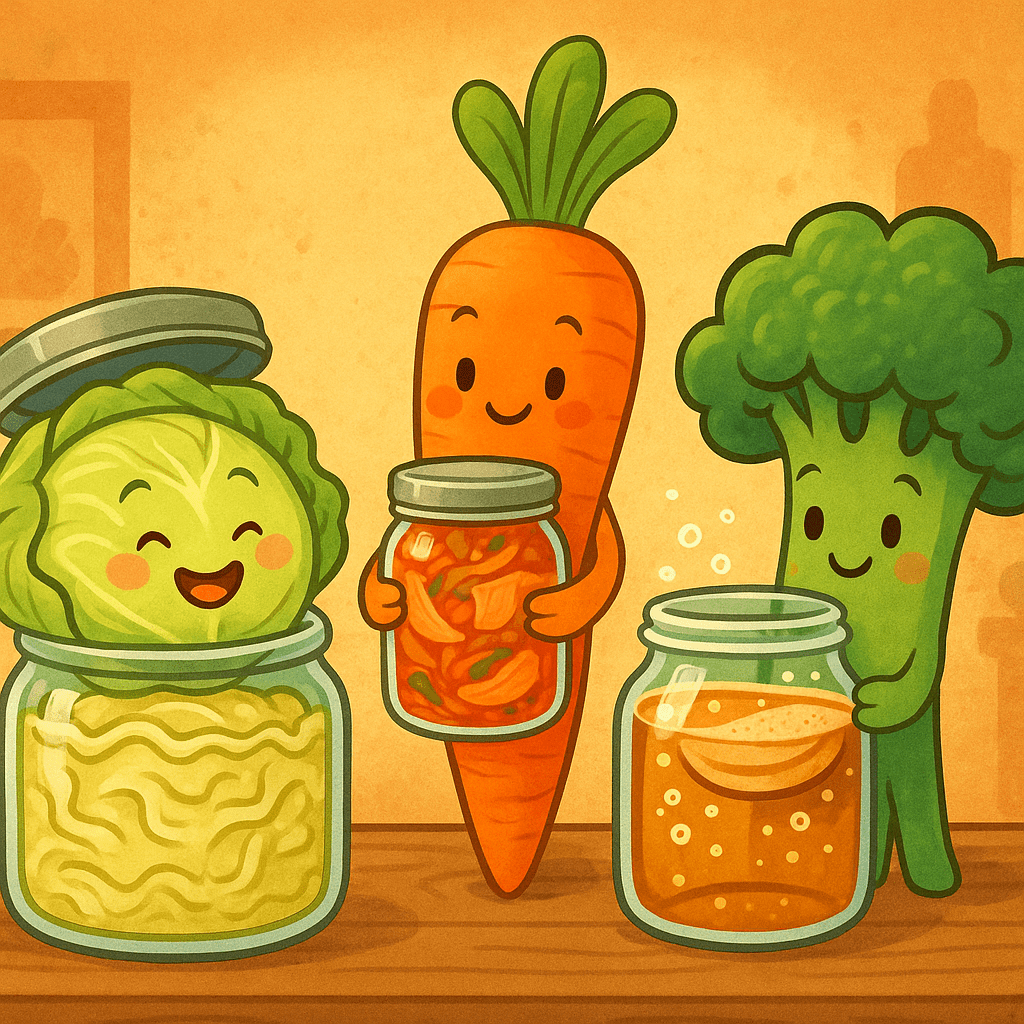
Cabbage in All Its Forms: Lacto, Chips, Salad, Roasted
Cabbage is cheap, it keeps for weeks, and it tolerates almost anything you do to it. Four treatments cover most of what it can do: lacto-fermentation, oven chips, raw slaw and roasting. Each one changes its texture, its flavour and, in some cases, its nutritional profile. This article walks through all four with the parameters that actually matter, the ones most recipe posts skip: salt concentration, temperature, pH, real fermentation times, and the situations that call for caution.
The short version
- 100 g of raw green cabbage provides roughly 25 kcal, 2.5 g of fibre, 36.6 mg of vitamin C and 76 µg of vitamin K, according to USDA FoodData Central. Raw red cabbage climbs to 57 mg of vitamin C per 100 g.
- For lacto-fermentation, aim for 2 to 2.5 % salt by weight of cabbage and a room between 15 and 21 °C. At that temperature, expect three to six weeks, not one.
- Never seal a screw-top jar tight during active fermentation: the CO2 has to escape.
- Sauerkraut is salty: about 661 mg of sodium per 100 g according to the USDA, close to 1.7 g of salt. That belongs in your daily total, which the WHO puts below 5 g of salt per day.
- “Probiotic” is not an authorised health claim in the European Union. The lactic acid bacteria in raw sauerkraut are real; the benefits attributed to them are not established.
- If you take warfarin, cabbage counts as a vitamin K food. Do not cut it out on your own, but raise it with your doctor or anticoagulation clinic.
What cabbage actually delivers
Green cabbage, red cabbage, Savoy, cauliflower, broccoli, Brussels sprouts and kale all belong to Brassica oleracea or to close relatives in the Brassicaceae family. Chinese cabbage and pak choi belong there too, under Brassica rapa.
USDA values per 100 g raw give a concrete picture:
| Per 100 g raw | Green cabbage | Red cabbage | Kale |
|---|---|---|---|
| Energy | 25 kcal | 31 kcal | 35 kcal |
| Fibre | 2.5 g | 2.1 g | 4.1 g |
| Vitamin C | 36.6 mg | 57 mg | 93.4 mg |
| Vitamin K | 76 µg | 38.2 µg | 390 µg |
| Calcium | 40 mg | 45 mg | 254 mg |
| Potassium | 170 mg | 243 mg | 348 mg |
A standard Swiss vegetable portion is 120 g, and the Federal Food Safety and Veterinary Office recommends three vegetable portions and two fruit portions a day. A generous bowl of slaw covers one of those five, not the whole day.
Glucosinolates: what is known and what is not
Brassicas are distinctive for their glucosinolates, sulfur compounds behind the pungent and sometimes bitter taste. When you cut or chew raw cabbage, an enzyme called myrosinase meets those molecules and converts them into isothiocyanates and indoles. The Linus Pauling Institute makes two points that popular coverage tends to distort.
First, boiling inactivates myrosinase and reduces glucosinolate content far more than steaming, microwaving or stir-frying. Colonic bacteria then take over part of the job, but with variable efficiency: a feeding study in 45 healthy subjects measured an average conversion rate of about 12 %, with individual results ranging from 1.1 to 40.7 %.
Second, high cruciferous intake is associated with lower risk of several cancers, but most of that evidence comes from case-control studies, a design vulnerable to recall and selection bias. Association is not causation. Eating cabbage regularly is sensible; expecting a demonstrated protective effect is not.
Cabbage and the thyroid, in proportion
The claim that crucifers damage the thyroid circulates widely. It rests on a real mechanism: hydrolysis of progoitrin yields goitrin, and hydrolysis of indole glucosinolates releases thiocyanate ions that compete with iodine for thyroid uptake. In animals, very high intakes have caused hypothyroidism.
In humans the picture is calmer. One study had participants eat 150 g of cooked Brussels sprouts daily for four weeks with no adverse effect on thyroid function. And the increased thyroid cancer risk associated with crucifers appears only in iodine-deficient areas. In Switzerland, where table salt has been iodised since 1922, the question mainly concerns people who combine a known thyroid disorder with low iodine intake. If in doubt, settle it with a doctor rather than by dropping an entire vegetable family.
Which variety suits which method
The varieties are not interchangeable, and the wrong choice explains a good share of failed attempts.
For lacto-fermentation, firm white cabbage is the best candidate. It is dense, juicy and sugary enough for the bacteria to acidify quickly, and it keeps some bite. Red cabbage works too, with a different colour outcome. Savoy, with its crinkled and looser leaves, releases less juice and softens faster; it is the harder choice for a first attempt.
For chips the opposite applies. What you want is thin, broad leaves with little water: kale first, then Savoy and pointed cabbage. The thick leaves of a headed cabbage dry too unevenly to make decent chips.
For raw slaw, white and pointed cabbage are the obvious picks because they shred very finely. Red cabbage needs more massaging and more acid, but repays you in colour. Chinese cabbage is naturally tender and needs neither a salt massage nor a long rest.
For roasting, choose compact heads that cut into stable slabs, so white cabbage, red cabbage and Savoy. Chinese cabbage falls apart at that heat.
Seasonally, cabbage in Switzerland is an autumn and winter vegetable, with stored heads carrying through to spring. Pointed cabbage is the tender early-summer type, and kale benefits from frost, which converts part of its starch into sugar and softens the flavour.
1. Lacto-fermented cabbage
What happens in the jar
Lacto-fermentation is not about adding bacteria: they are already on the leaves. Salt and the absence of air give them the advantage over undesirable microorganisms.
The sequence is well documented. Leuconostoc mesenteroides starts things off, quickly producing carbon dioxide and acid, which drops the pH and shuts out spoilage organisms. By acidifying, it creates conditions that favour more acid-tolerant species, notably Lactobacillus brevis and Lactobacillus plantarum, which finish the job. A 2018 microbiome analysis of sauerkraut published in Foods confirmed by sequencing that this community establishes fast and stays stable through packaging.
Traditional fermentation runs at around 18 °C for roughly a month. The endpoint that matters for safety is a pH of 4.6 or below, the threshold under which a preserve counts as acid.
Salt, temperature, timing: the real numbers
Clemson University Extension publishes the reference values, and they differ from what circulates online.
- Salt. The target final concentration is 2.25 to 2.5 %, which favours the leuconostocs. Dropping well below 2 % weakens the barrier against unwanted bacteria. For 1 kg of shredded cabbage, that means 20 to 25 g of salt, weighed, not estimated by the spoonful.
- Temperature. Between 15 and 18 °C, fermentation takes five to six weeks. Between 21 and 24 °C it finishes in three to four weeks but yields a more acidic, less aromatic product. Below 15 °C it may not start at all. Above 24 °C the cabbage goes soft.
- Submersion. The cabbage must stay covered by 2 to 5 cm of brine. If liquid runs short, top up with a brine of roughly 22 g of salt per litre of boiled, cooled water.
- Container. Stoneware, glass or food-grade plastic. Never aluminium, copper, brass, iron or galvanised metal: those react with the acid and salt, discolour the kraut and leach into it.
The most commonly mangled point is the lid. A screw-top jar sealed tight during the active phase traps the CO2 the bacteria produce. Use a jar with a rubber gasket, which lets excess gas out, or loosen the lid once a day.
A word on the salt itself. Tested recipes from university Extension services specify canning or pickling salt, meaning salt without additives. Anti-caking agents cloud the brine and added iodine can slightly darken the product, without any safety implication. Untreated sea salt or rock salt works perfectly well. In any case the quantity matters far more than the type.
The method, step by step
- Pick firm heads and work with them within 48 hours of purchase.
- Discard the outer leaves, which carry most of the undesirable microorganisms, then rinse the heads under cold water.
- Quarter, core, and shred to about 5 mm. That fineness increases surface area and makes the cabbage sugars available to the lactic acid bacteria.
- Weigh the shredded cabbage, add 2 to 2.5 % of its weight in salt, mix with clean hands.
- Knead and pack in layers until the salt draws out the juice.
- Fill the jar, press down, and top up with brine if the juice does not cover.
- Add a weight, a reserved cabbage leaf or a food-grade bag filled with brine, to keep everything submerged.
- Ferment at 15-21 °C away from direct light, checking the liquid level two or three times a week and skimming off any scum.
- Start tasting in week three. When the acidity suits you, move it to the fridge.
According to Fred Breidt, a USDA microbiologist specialising in the safety of fermented foods, the scientific literature has never recorded a case of food poisoning from raw vegetables that were fermented properly. The operative word is “properly”: good raw material, no contact with manure or improperly cured compost, and washed hands, utensils, work surfaces and containers.
What fermentation gives you, and what it does not
The marketing vocabulary around sauerkraut deserves to be brought back to verifiable facts.
In the European Union, no health claim for probiotics has been approved. The Food Safety Authority of Ireland notes that the word itself counts as an implied health claim and that more than a hundred applications have been rejected. The only authorised claim involving live bacteria concerns improved lactose digestion by L. delbrueckii subsp. bulgaricus and S. thermophilus in yoghurt, which has nothing to do with sauerkraut. Writing that fermented cabbage “boosts the immune system” is therefore not defensible.
Vitamin C needs a caveat too. Raw cabbage carries 36.6 mg per 100 g; the canned sauerkraut in the USDA database retains only 14.7 mg. Raw, unpasteurised sauerkraut kept cold does better, but fermentation does not preserve everything. Fibre comes through fine: 2.9 g per 100 g of sauerkraut against 2.5 g for fresh cabbage.
The real watchpoint is salt. Again per the USDA, 100 g of sauerkraut supplies about 661 mg of sodium, the equivalent of 1.7 g of salt. A 150 g serving alone accounts for half the WHO daily ceiling. Rinsing sauerkraut briefly before serving removes some of it.
Who should be careful
Fermented foods contain biogenic amines, formed by decarboxylation of amino acids during fermentation. A 2024 review in Heliyon reports that some fermented foods exceed the doses considered toxic for histamine, tyramine or phenylethylamine, and that individual sensitivity varies widely. Alcohol and certain medicines, monoamine oxidase inhibitors in particular, lower the reaction threshold sharply. Migraine, raised blood pressure and tachycardia are among the described effects.
In practice: if you take MAO inhibitors, if aged cheese and red wine set you off, or if you have reacted after a meal of charcuterie or ripened cheese, introduce homemade sauerkraut in small amounts and discuss it with a health professional. The same levers that limit biogenic amines are the ones behind good fermentation practice: fresh raw material, strict hygiene, controlled storage.
One more situation calls for attention: warfarin. The NHS states that foods high in vitamin K affect how this anticoagulant works, and advises against major dietary changes without talking to your clinic. Cabbage is on the list, kale more so with its 390 µg of vitamin K per 100 g. The principle anticoagulation services apply is not avoidance but consistency: a steady intake beats alternating between weeks with no greens and weeks of kale smoothies.
2. Cabbage chips
Why it works
Kale, Savoy and pointed cabbage leaves lose almost all their water in the oven and turn brittle. You get a very light snack, provided you accept the yield: a large bunch of kale gives one small bowl of chips. That is exactly what makes a “high in fibre” claim misleading on this kind of preparation, since the portion you actually eat weighs a few grams.
A note on acrylamide, often raised about chips. The compound forms mainly in starchy foods cooked above 120 °C at low moisture, and EFSA lists potato crisps, French fries, bread, biscuits and coffee. Cabbage is not a starchy food, so the issue matters far less here than for potatoes. What deserves attention in a homemade cabbage chip is the amount of salt and oil you add.
The method
- Preheat the oven to 150 °C, fan if available.
- Strip out the thick central ribs, which stay tough, and tear the leaves into palm-sized pieces.
- Wash, then dry stubbornly. This is the decisive step: a still-damp leaf steams instead of drying, and you get limp instead of crisp. A salad spinner followed by a clean tea towel does the job.
- Massage the leaves with very little oil, a teaspoon for a large handful is enough. Too much oil weighs them down and blocks crisping.
- Spread in a single layer on parchment, no overlap.
- Bake 10 to 15 minutes, watching from minute eight. Edges brown fast and turn bitter.
- Salt when they come out, not before: salt applied raw draws water out.
Chips soften within hours in open air. In an airtight box with ambient humidity, they hold one or two days at best. For variety, nutritional yeast gives a cheesy note, smoked paprika adds depth, and a pinch of toasted sesame seeds brings back some crunch.
If you own a dehydrator, running it at 45 to 55 °C for several hours gives a more even result than the oven, because the low temperature never scorches the edges. The time cost rises from a quarter of an hour to half a day, though, and the flavour gain is small. For everyday use the oven remains the practical option.
3. Cabbage salad
The principle: break down the fibre
Raw cabbage is firm because its cell walls are intact. Three levers soften them.
Fine cutting first. A mandoline or a good knife set to 1 or 2 mm changes everything compared with thick ribbons. Massaging next: a teaspoon of salt worked into 500 g of shredded cabbage draws out water in ten to fifteen minutes and tenderises noticeably. Rinse and press if the result tastes too salty. Acid last: lemon juice or vinegar works in the same direction and holds the colour, especially with red cabbage, whose anthocyanins turn blue-grey in alkaline conditions.
Plant-based coleslaw
For four people as a side:
- 500 g white cabbage, finely shredded
- 2 medium carrots, grated
- 1 tart apple in fine julienne, optional
- 2 tbsp vegan mayonnaise
- 2 tbsp plain plant yoghurt, soy or coconut
- 1 tsp mustard
- 1 tbsp cider vinegar
- 1 tsp maple syrup
- Salt, pepper, sunflower seeds
Mix the dressing separately, pour it over the vegetables, and rest at least an hour in the fridge. The slaw improves over twelve hours, then starts weeping water: make it the night before for tomorrow’s lunch, not three days ahead.
For a version with no added fat, swap the dressing for two tablespoons of rice vinegar, a teaspoon of toasted sesame oil and a little grated ginger. The result sits closer to a Japanese namasu than a coleslaw, and it works well alongside legume-based dishes.
4. Roasted cabbage
The oven transforms cabbage more radically than any other method. Dry heat evaporates water, concentrates sugars and triggers browning reactions that produce nutty notes. The edges caramelise and go almost crisp while the core stays tender.
- Preheat to 200 °C.
- Cut a head of green or Savoy cabbage into 2 cm slabs or wedges, keeping a piece of core so the leaves hold together.
- Brush both faces with olive or rapeseed oil, salt and pepper.
- Roast 25 to 30 minutes, turning halfway.
- Serve with a squeeze of lemon, or a tahini sauce loosened with water and garlic.
Pairings that work: ground cumin and coriander, smoked paprika, mustard seeds, or a finish of reduced balsamic. Roasted cabbage goes with whole grains, chickpeas, green lentils and grilled tofu. The other vegetable cooking techniques are worth testing alongside: steaming and stir-frying preserve more glucosinolates than boiling, which is a concrete reason to vary your methods.
Storage and planning
A whole, uncut head of green cabbage keeps for several weeks in the fridge drawer or a cool cellar. Once cut, it oxidises along the cut face: wrap it and use it within a few days, or shave off the browned surface before use. Savoy and kale, being more fragile, keep noticeably less time. The wider vegetable storage rules apply here too.
For freezing, blanch two to three minutes then cool immediately in iced water. Without blanching, enzymes keep working and the cabbage loses texture and flavour in the freezer.
Homemade sauerkraut, once moved to cold storage, keeps for months as long as it stays submerged and the jar shows no putrid smell, no fuzzy coloured mould and no slimy texture. A white film on the surface, known as kahm yeast, is not dangerous but spoils the flavour: skim it off and check submersion. If you have serious doubts, discard the jar rather than taste it.
Cabbage in Swiss kitchens
Sauerkraut is a fixture here, usually served warm as a side and traditionally seasoned with juniper berries, bay and caraway. A vegetarian version swaps the bacon for browned onions, a splash of apple juice and a little rapeseed oil; the result stays savoury without anything missing. Worth distinguishing: the cooked sauerkraut on the plate and the raw kraut from the chilled section are not the same product. Heating kills the lactic acid bacteria, while the flavour and the fibre survive.
Savoy and red cabbage also feature in Swiss winter menus, often braised with apple and vinegar. The vinegar serves a practical purpose beyond taste: it holds the colour of red cabbage, which otherwise drifts towards blue. Locally grown cabbage is available from October into spring, which puts it among the vegetables that carry a household through winter without imports.
Common mistakes
- Measuring salt by spoon instead of by weight. Coarse and fine salt differ a lot in density. A kitchen scale solves it.
- Fermenting in a 25 °C summer kitchen. The cabbage goes soft. Find a cellar, a pantry or the coolest room you have.
- Screwing a jar lid down tight. Gas builds up.
- Stopping fermentation after three days because “it is bubbling”. Bubbles signal the start, not the finish.
- Overloading the chip tray. Overlapping leaves steam.
- Salting slaw and serving immediately. Salt needs ten to fifteen minutes to tenderise.
- Treating sauerkraut as salt-neutral. It is not.
Frequently asked questions
Do I need whey or a shop-bought starter culture? No. The lactic acid bacteria you need are already on the leaves. Salt and the absence of air are enough to select for them.
Does red cabbage ferment as well? Yes, with a bright pink result. Its anthocyanins respond to pH, so the colour shifts during fermentation.
Does supermarket sauerkraut contain live bacteria? Only if it is sold chilled and unpasteurised. Shelf-stable canned versions are heated, which kills the bacteria and cuts vitamin C.
Does cabbage cause bloating? It contains fermentable fibre that produces gas in the colon. Increasing quantities gradually, chewing well and cooking rather than eating it raw helps most people. Anyone on a low FODMAP protocol should discuss it with their dietitian.
Can I eat cabbage every day? Nothing prevents it in a healthy adult, within the five daily portions of fruit and vegetables. The caveats concern mainly people on warfarin and those combining a thyroid disorder with insufficient iodine intake.
Does cabbage count as a protein source? No. At 1.3 g of protein per 100 g, it accompanies a dish rather than anchoring it. Pair it with legumes, tofu or whole grains. Vegetarians also need to watch their vitamin B12 and iron intake, two nutrients cabbage does not supply in useful amounts.
How do I know a ferment has failed? Rely on three signals: a putrid rather than sour smell, fuzzy coloured mould on the surface, and a slimy or stringy texture. Cloudy brine and a white film alone are not grounds for throwing it out. When you genuinely suspect a problem, the rule is simple: discard, do not taste.
Going further
If fermentation appeals to you, the step-by-step sauerkraut workshop covers the method in detail, and the page on homemade lacto-fermentation safety deals with warning signs. For a result in 24 hours rather than a month, quick pickles rely on vinegar acidification rather than fermentation. On the meal side, cabbage earns a place in a complete meal salad, and parents looking for ideas can consult our notes on getting children to like vegetables.
Sources
- WHO, Healthy diet
- FSVO, Swiss dietary recommendations for adults
- USDA FoodData Central, cabbage raw (169975)
- USDA FoodData Central, sauerkraut canned (169279)
- Clemson Cooperative Extension, Making Sauerkraut
- Zabat et al., Microbial Community Analysis of Sauerkraut Fermentation, Foods 2018
- Linus Pauling Institute, Cruciferous Vegetables
- Saha Turna et al., A review of biogenic amines in fermented foods, Heliyon 2024
- Food Safety Authority of Ireland, Probiotic Health Claims
- EFSA, Acrylamide
- NHS, Warfarin
- NHS, The vegetarian diet